

Den Internationale Fredskoalition møde #115 den 15. august 2025


På engelsk:
Aug. 15, 2025 (EIRNS)—What follows are the opening remarks, some remarks during the discussion and closing remarks of Helga Zepp-LaRouche at the International Peace Coalition meeting Number 115 today:
ANASTASIA BATTLE: Welcome everyone. This is the International Peace Coalition. This is the 115th consecutive meeting we’ve had. Thank you all for joining us. My name is Anastasia Battle; I’ll be your moderator along with my co-moderators Dennis Small and Dennis Speed.
I like to remind everyone why we created this forum 115 weeks ago, which was to unite the international peace movement. As everyone is well aware, there are many efforts to split us apart, divide us, and keep us from communicating. But if we actually want to achieve true peace in the world, we need to bring together people of many different philosophies, ideas, cultures, and religions in order to accomplish this goal. I thank you all for joining us in that effort. Please take a moment to share this invitation with other people who you know; other organizations, your friends, family, respectable enemies who can understand what we’re doing here today.
To start us off, we have Helga Zepp-LaRouche, who is the founder of the Schiller Institute and initiator of the International Peace Coalition. Please, go ahead Helga, and start us off for the meeting.
HELGA ZEPP-LAROUCHE: Let me say hello to all of you. Today is obviously an extremely potentially very fateful day, because today you have the meeting between President Trump and President Putin and their delegations in Anchorage, Alaska. A lot has been said, a lot of people have voiced either panic or hope, sarcasm, cynicism. I think we will know in a few hours from now what the outcome of this meeting will be. Let’s not speculate, because our approach is not the reading of tea leaves but rather an organizing approach. The reason we were totally excited when we heard the news about the location of that meeting, was because the location of Alaska brings forward the potential of building the tunnel through the Bering Strait to connect the Eurasian landmass with the Americas through an infrastructure corridor. If you look at the composition of the delegation on the Russian side, you have very powerfully, Lavrov, Shoigu, Ushakov, but also Kirill Dmitriev, who is the present president of the sovereign wealth fund of Russia. He has come out repeatedly in the past for the construction of the Bering Strait tunnel.
Why is this so important? Obviously, this is a project which goes back to the middle of the 19th century to the time of Lincoln. It has encouraged the vision of many people ever since, but in the recent several decades, this has been part of a program which was very much promoted by my late husband and myself. Namely in the context of the World Land-Bridge, the idea that eventually very soon one could connect all continents through infrastructure corridors—either tunnels or bridges—so that soon you would be able to travel with maglevs or other fast train systems from the southern tip of Argentina and Chile all the way up through Latin America, Central America, North America, Canada, Alaska, and then through the Bering Strait into Russia, and from there all of Eurasia, then through a tunnel at Gibraltar, or maybe from Sicily a bridge to North Africa, all the way through Africa to the Cape of Good Hope. And likewise, other connections through the Indian Subcontinent and tunnels and bridges into Indonesia and other countries in that region. So, eventually, the idea that we would be united through a network of infrastructure connecting the economies and civilizations around the globe into one interconnected one. Provided that we don’t have World War III, that is the natural course of events that will happen sooner or later. But if it happens now, it could be a very important piece of war avoidance.
I’m hopefully optimistic that this may be on the agenda, simply because it is such an obvious potential. President Putin has mentioned in the recent several years repeatedly—especially in the context of the Vladivostok Eastern Economic Forum—the incredible economic potential which lies in the development of the untapped raw materials in the Far East and Siberia, much of which is under permafrost conditions and therefore has not yet been developed. But if there would be such an infrastructure connection, even these climatic difficulties could be overcome. There are modern ways of building cities even under permafrost conditions.
Given the fact that also President Trump is known to be a real estate expert, he has for sure a sense of it; and I’m absolutely certain that that potential has not escaped his mind. It would be a perfect way to outflank all of his opponents, including the very strange Europeans who are presently calling themselves the Coalition of the Willing, who have tried everything to prevent Trump from ending the Ukraine war. The recent example being Chancellor Merz of Germany, who just two days ago had a meeting in his office in which the only other physical participant was Zelenskyy. But he was connected via Zoom with the other European heads of state who are part of the Coalition of the Willing. They said, “We have absolute conditions for what must come out of this meeting in Alaska. There can be land swap; there must first be a ceasefire.” Basically repeating the conditions, including Ukraine’s access to NATO, listing all the reasons why the war is happening in the first place, because it did encroach on the core interests of Russia’s security interests; and therefore it came to this very unfortunate development of the Ukraine war. I’m pretty sure that while ending the Ukraine is a very important topic, also for Trump and Putin, I don’t think it’s the most important topic. First of all, the military gains of Russia in Ukraine are spectacular, and all experts expect that that war will end anyway in a few weeks, simply because of the collapse of the Ukrainian forces. And just two days ago, Russia destroyed a factory which was building long-range missiles, the Sapsan missile which was financed by a consortium of European nations. It’s basically like the Taurus missile, but enabling Ukraine to build it on their own soil. That has been destroyed, and with it the option of equipping Ukraine with these long-range missiles.
I think much more important for Russia is the potential to normalize relations with the United States. I think if you study the recent Russian formulations, articles, statements, it is very clear that what matters to them is the immediate potential that the present crisis over Ukraine could escalate into a global nuclear war. Given the fact that you have a warmonger faction on the side of the Europeans in particular, I think they are looking at the potential of normalizing relations with the Trump administration as the primary desired outcome of the process of discussion. Hopefully going beyond Alaska, and having follow-up meetings also including the prolongation of the new START Treaty, which otherwise will run out in the beginning of 2026; maybe negotiating a new INF Treaty. These kinds of things are, in my view, much more the core security interests of Russia than even the battlefield situation in Ukraine, which I think Russia thinks they have pretty much under control.
So, I think that is the immediate situation there. As I said, we will know in a few hours.
But let me just bring in one more dimension of why this infrastructure development is so important. It’s not just a way to increase trade. If the tunnel in the Bering Strait will be built, it is the estimate of a railway expert named Scott Spencer that it will make possible the transport of 400 million tons of cargo every year, which is enormous. But more than just one specific aspect, I think if you look at the role of infrastructure in the development of the human species in general; just think back over the last 10,000 years. Then infrastructure developed from the coastlines, from the rivers, eventually with the development of railways, it went more into the interior of the continents. More and more it opened up all continents for human population. Friedrich List, who is probably the best German economist, the head of the Customs Union, who wrote very important books about the difference between the English system of economy and the American System of economy. He had a beautiful vision of what could happen if all of mankind would be united through infrastructure connections. He coined the notion in an article he wrote in 1837 for the French Academy of Sciences, in which he developed the notion of a space and time economy. He said that the permanent completion of the transport and communication systems would be the precondition for the progress of humanity, and enable them to fulfill all of their potentials and increase all areas of knowledge to inspire the sciences and arts to cause people to make inventions in all kinds of disciplines. The more quickly people could move from one place to the next, and the more closely space would come together in this way, it would increase the efficiency and development of all human powers and increase the living standard of the population for the benefit of all. He said it much more beautifully than I’m paraphrasing it now, but he gave to this development of infrastructure this civilizational quality that it uplifts people; it humanizes them and makes them work together more.
This is also important for the other crisis area which I want to address, and that is naturally the unspeakable situation around Gaza, where the genocide is fully going on. It makes you speechless, because one asks what more does it take until humanity intervenes in this genocide which is in front of the eyes of the whole world, because all the TV stations transmit it? There is now no more question that mass starvation, famine, malnutrition of thousands of children is going on every day. It seems that the General Chief of Staff Zamir is preparing the invasion of Gaza City. [National Security Minister Itamar] Ben-Gvir is escalating the annexation of the West Bank, where new settlements have been ordered so that the option of a Palestinian state is made impossible simply by these mass settlements.
So, this is the situation where we absolutely have to escalate our campaign. But I think Francesca Albanese is absolutely to the point when she said that people should not be fooled by the sudden and very late recognition of many European and other leaders from Canada, Great Britain, New Zealand, France, who all of a sudden call for the creation of a Palestinian state. That must not be a distraction from the ongoing genocide. That brings me to the point of the connection of infrastructure and solving the crisis for the Palestinian people. We have said the whole time that the only way you can solve it is not just a political solution which would be a Palestinian state. It must be combined with economic development: with the Oasis Plan which we have been promoting now for several decades. This was the idea of my late husband, Lyndon LaRouche, and which has now been discussed by many people in the Middle East. There are many forces who agree that if there is any hope for a peaceful future, it must be economic development; greening the desert in the entire region from India to the Mediterranean to the Caucasus to the Gulf States, to transform that region into economic prosperity. Connecting it with the tradition of the ancient Silk Road, when that region of the world was already once the hub connecting Asia, Africa, and Europe. That is what it has to become again in the future.
I think this is a very dramatic moment in history, and I’m very happy that we have very knowledgeable speakers today to enrich our discussion. We should really look at this whole situation not as something to comment on, but we plan to bring this idea of the World Land-Bridge as a solution to these crises to more and more fora. On September 3rd, there is not only the historic 80th anniversary of the end of the Second World War in the Pacific in Beijing with a big parade. We have made an appeal to President Xi Jinping to absolutely invite President Trump to participate. President Putin will already be a guest of honor, and on the same day in Vladivostok is the start of the Eastern Economic Forum, where the issue of Arctic development will already be on the agenda. So, that is a perfect opportunity to bring in the Bering Strait development, but also the idea of a new security and development architecture, which I think is the precondition to finding a solution for the crisis in the Middle East.
So, let’s discuss all of that, because this gives us plenty of opportunity to intervene to try to shape the outcome of this historical moment.
Remarks during the Discussion:
I just would like to bring in one more consideration. That is that in observing how the international community has proven to be incapable of reacting to what I call a genocide before our eyes, that means that we, as humanity as a whole, are in a deep cultural and moral crisis. Not just the genocide going on in Gaza. I can go through all the different reactions, but the fact that we are not capable of doing something about it. You can say if you want to fight it, you have to fight the United States, and who can do that? But obviously the UN Security Council has been blocked: They were completely unable—even the provision that you can go to the UN General Assembly if there is an injustice which cannot be resolved by the UN Security Council did not resolve the situation. That creates a real problem which I think needs to be addressed very urgently.
The second thought I want to mention is that there is a need to separate, to get a clarity on the fact that we cannot allow—even in the face of the greatest evil—to in any way let that evil impact our souls. I know that many Palestinians say you cannot have an Oasis Plan, because first, you need justice. Well, that is true in one sense, but there is a very important line in Friedrich Schiller’s play, Wallenstein. I’ll say it in German, and then try to translate it. It says [in English], “It is the curse of the evil deed that it permanently has to give birth to more evil.” I think that is a very important consideration, because if we are not capable of breaking through the cycle of violence, of revenge, and doing justice in the name of justice, getting back at the other one, I think we have reached a point in the history of humanity where we have to be able to take the level of the Sublime. Nicholas of Cusa had this idea of the Coincidence of Opposites, that the human mind always has to be able, and is able, to conceptualize a solution which is on a higher plane than the lower plane on which the problem arose. I think that challenges us to make a cultural leap. We have to apply the principle of aesthetic education to solve this problem by bringing in relation to the best of the other. I know this is very difficult when you are dealing with a concrete situation like in Gaza, but I would like to bring in these considerations, because I think they are extremely important.
I’m not claiming that I have the final answer to them, but they seem to be extremely important to me.
[re role of British Empire in escalating crises and alternative of Alaska meeting] I also want to address what Mr. Berg said, that he doesn’t totally know what the Global South is up to. What the Global South is up to is a reaction, a blowback to the policies which you can take back 500 years. They want to end the colonial system of the last 500 years. What started in one way with the Non-Aligned Movement and the Bandung Conference in 1955 could not succeed at the time, because these countries were not strong enough to realize their intention and their right to global development. Then they tried it again in the 1970s, when we had a big role by my late husband Lyndon LaRouche making the proposal for a new development bank, the International Development Bank, which was adopted by the Colombo summit in 1976 of the Non-Aligned Movement.
But again, they were not strong enough to carry it through. There was an immediate blowback against Indira Gandhi, Mrs. Sirimavo Bandanaraike from Sri Lanka; Zulfikar Ali Bhutto was even killed. It took a long time for them to come back. Even if you don’t agree with it, I still absolutely insist that it is because of the rise of China that these countries of the Global South now have, for the first time, a partner who provides them with economic cooperation so that they can develop some of their aspirations to become developed countries in the near future.
So, the British Empire in short, which is not limited to a country—it’s not Great Britain—what we call the British Empire is the remnant of the system of empire trying to suppress them; to build the power of colonialism, of imperialism. And which, after the Second World War, in the person of Churchill, started the Cold War at a point it was absolutely not necessary, by drawing up “Operation Unthinkable,” which was the idea of a preemptive [nuclear] attack on the Soviet Union, which had just courageously defeated the Nazis in the Second World War. The same British Empire, together with their partners in the United States, the neo-cons, decided to create a unipolar world with the not so nice means of regime change, color revolution, and whatnot. What you see right now in terms of the blowback coming from the Global South is that they do not agree to that system of oppression anymore. That in the recent period has very clearly put the British Empire in the form unfortunately also of the British government in total opposition to the emergence of this new system. They have been the key instigators of every escalation in Ukraine, and in many other parts of the world. So, I think that is just a short answer.
Then I just want to comment also that you attacked what you called the illiberal countries. I mean I find it quite illiberal to attack these countries in this way, because I think they deserve a much closer view. Since you said that it is the elected governments that should not be attacked, you had argued earlier, and now you are attacking all of them. All of these were democratically elected by their people. Their people obviously have the feeling that they are doing a very good job, like in the case of [Hungarian Prime Minister Viktor] Orbán, with whom I do not agree on his Israel policy, but with whom I fully agree on his policy towards the European Union. So, I think we need to have a little bit more differentiated view on all of this.
But I really want to come back to one key idea. I said in my initial remarks, and I agree with whoever mentioned this just now, maybe Dennis or Ray, that what is at stake in Anchorage is the potential for a new security architecture, which we are urgently in need of; because the old one has just fallen apart in front of our eyes. If you can have a government negotiating on the nuclear issue in Iran, and then at the same time preparing a military attack, that means there is no more order. It means that every rule and every decency in international law has just been abandoned and thrown out the window. In the same way as the condoning of the genocide in Gaza means the international order no longer exists. It’s a matter of the past. Therefore, I think we are in absolute urgency to establish a new security and development architecture which I have argued the whole time needs to take into account the interests of every single country on the planet; or else it will not work. There is a precedent for that—the Peace of Westphalia; where people came together to establish principles like the first one, that in order to have peace, you need to respect the interests of the other. That means all others. I unfortunately have come to the conclusion that as much as I think the Oasis Plan is the only way we can save the Palestinians and the whole region, I think that the Oasis Plan can only work if it is an adjunct to such a new security and development architecture. Because otherwise you don’t get the power combination to make it happen. So, that’s why I really urge people to think through these matters. I think we have reached a point where we need to establish a New Paradigm in international relations, or else we will not make it.
Closing Remarks:
I would like to now conclude with an emphasis on going back to the historic moment in which we find ourselves. Today probably in two or three hours, we will know what comes out of this Anchorage meeting; and that will be decisive. Because if it goes in the direction that there is no understanding, we are back to square one on the verge of World War III; because then the Ukraine war can go out of control in the short term.
If however, there is an understanding that there should be a return to disarmament discussions, to a normalization between the two largest nuclear powers in the world, then there is hope. It does not solve the problems; it does not remedy all the problems which were mentioned about President Trump and whatnot. That is a different matter. But if the idea of development is back on the agenda, as it would be in the case of the Bering Strait as the bridge between the Americas and Eurasia, we are in a different universe, or the beginning of a different universe. And therefore, given the urgency of the situation, I would like the participants in this panel to reflect on what can be done in the short term to formulate a policy which could save the lives of the Palestinians; because obviously time is running out.
The forum would be the United Nations General Assembly. I don’t know if the Uniting for Peace Resolution gives a handle on that; I think Mr. Falk you are the expert on that matter, so please come forward with ideas. Otherwise, I would say we have now two weeks until the coincidence of the 80th anniversary of the end of the Second World War in the Pacific. Part of the history which has been completely neglected in the Euro-centric view of history, is that China played a very important role in the defeat of the Nazis by fighting against the Japanese militarism and preventing a two-front war for the Soviet Union, because they tied down the Japanese in the Pacific. They lost all together about 30 million people, and that has been completely left out of history; at least European Western history. That will be remedied on this occasion of the military parade in Beijing on September 3rd. I think the fact that the Chinese choose the form of a military parade, where they will for sure display their most modern weapons systems—at least that’s what I would assume—is a message to the world to remember not to have world war ever again. That is still the big Damocles sword which hangs over all of us.
Therefore, I will call on the members of the International Peace Coalition—at least those who agree with that approach—to really try to put on the agenda of many people the idea of a new security and development architecture combined with the idea of a global development perspective as I suggested in my Ten Principles for discussion as to what such an architecture could look like, and that we really try to increase the IPC. We need to reach out to many more people, because if we manage to get President Trump to this event in Beijing, I think the impact of that will help to make things clearer not only for Trump, but also all the people who are watching this.
Secondly, at the same time—September 3rd—the Vladivostok Eastern Economic Forum will start. I would strongly advise you to put your eyes on that. I’m sure many countries of the Global South will be represented there, and they will discuss how to overcome colonialism by investing in development projects. I think people in the West have to start to really understand what are the aspirations of the countries of the Global South, because they do want to end the time of colonialism. People have to understand that much better.
So, to sum it up, get active with us, because we have a short window of opportunity to still save this poor human species and bring it to a better era. So let’s not miss it.

Relaterede Artikler
-
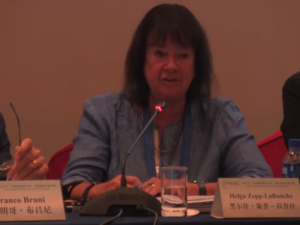
China Daily har også en artikel om Helga Zepp-Larouche i sin dækning af Bælt & Vej
-

Specialrapport:
Lyndon LaRouche: Evnen til at gøre det gode
– Mennesket har en særlig opgave i universet -

Præsidentvalg Frankrig 2017:
Jacques Cheminades kampagne fortæller Sputnik,
hvorfor Fillon og Le Pen betyder blod og tårer for Frankrig -
Tidligere italiensk finansminister opfordrer til et nyt Bretton Woods