

Zepp-LaRouches ti principper


The original English version is found after the Danish translation.
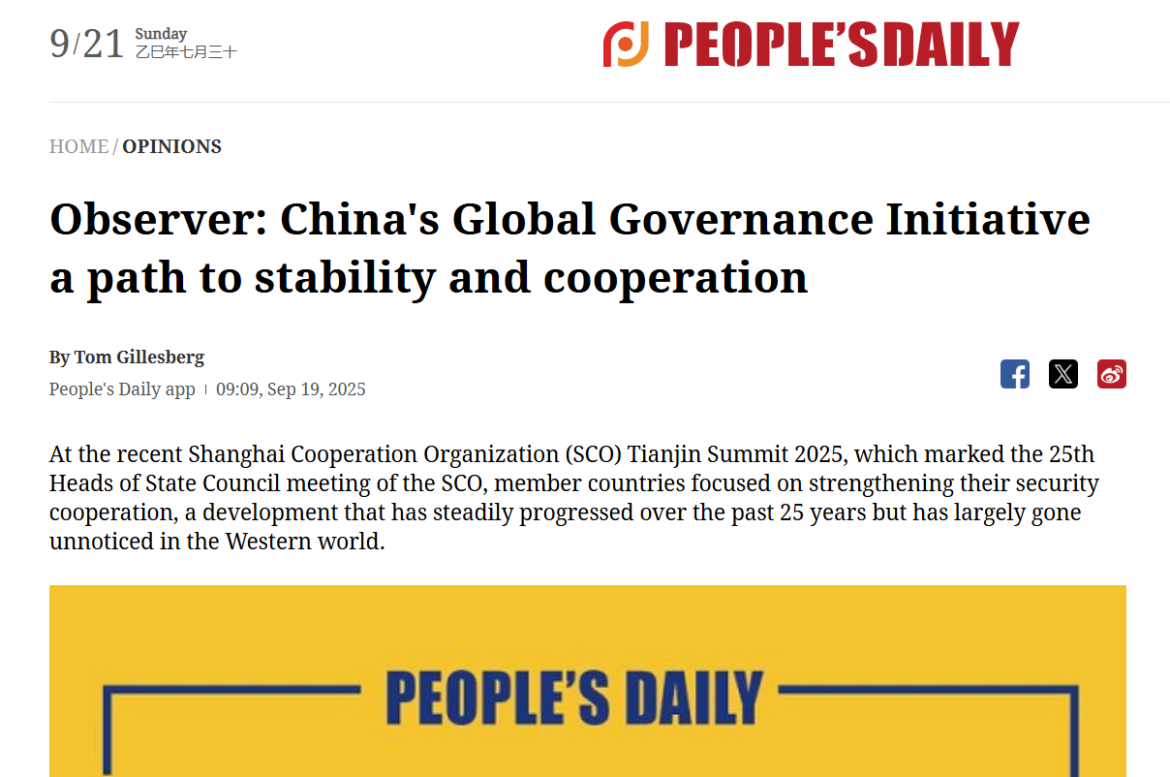
19. september 2025 (EIRNS) – People’s Daily, den største statsstyrede kinesiske avis, offentliggjorde den 19. september et læserbrev fra Tom Gillesberg, formand for Schiller Instituttet i Danmark, om Xi Jinpings Global Governance Initiative. Titlen var »Kinas Global Governance Initiative – en vej til stabilitet og samarbejde«.
Brevet, som var redigeret af People’s Daily fremhævede Helga Zepp-LaRouches ti principper for en ny international sikkerheds- og udviklingsarkitektur:
Gillesberg præsenterede GGI som en vigtig fortsættelse af den dialog, der skal bringe orden i verden efter den igangværende nedbrydning af den unipolære orden, med en kort præsentation og diskussion af GGI’s fem nøgleprincipper. Han inkluderede også sine refleksioner over, hvordan GGI ser ud fra et dansk perspektiv.
Brevet, som det blev offentliggjort, sluttede med:
“Løsningen ligger i at vende tilbage til principperne om suverænitet og samarbejde – ikke kun blandt vestlige nationer, men i et ægte samarbejde med resten af verden. Denne vision er i overensstemmelse med den multipolære verdensorden, der er skitseret i GGI’s fem principper.
Redaktørerne af People’s Daily forkortede og redigerede brevet, blandt andet ved at udelade den polemiske indledning, der afslørede den unipolære elites ødelæggelse af alle retsprincipper, som det fremgår af Israels krig mod Gaza, angrebet på Qatar, Europas manglende suverænitet i forbindelse med accepten af den nylige handelsaftale og de ulovlige angreb på venezuelanske skibe.
Her er den forkortet og redigeret version på People’s Daily’s hjemmeside den 19. september 2025.
Her er den danske oversættelse af Tom Gillesbergs fulde oprindelige artikel:
Kinas Global Governance Initiative:
Et sæt principper, der kan redde verden fra at synke ned i permanent kaos og krig
Af Tom Gillesberg, [formand for Schiller Instituttet i Danmark]
KØBENHAVN, 13. september 2025 – Hver dag kommer der nye utrolige historier, der viser en verden, der ikke længere fungerer efter nogen retsprincipper.
I næsten to år har verden været vidne til, at Israel har begået folkemord på den palæstinensiske befolkning i Gaza foran rullende kameraer, på trods af protester fra langt størstedelen af verdens nationer, og alle forsøg på at få FN’s Sikkerhedsråd til at gribe ind er blevet standset af USA’s veto. Ledere af store europæiske nationer har afskaffet enhver form for uafhængig politik og national suverænitet og har slavisk fulgt USA’s anvisninger.
Dette blev for nylig demonstreret, da EU opgav kampen mod USA’s ensidige told på EU-eksport, og tv-billeder viste EU-ledere siddende foran den amerikanske præsident som små skolebørn, der ventede på at høre, hvilken ny form for straf og selvskade de skulle udføre for at forblive venner med USA.
Den amerikanske præsident offentliggjorde stolt en video på sin sociale medieplatform, hvor det amerikanske militær tilintetgjorde en venezuelansk civil speedbåd i internationalt farvand med 11 personer om bord, uden noget juridisk grundlag i hverken amerikansk eller international lovgivning. Dette blev efterfulgt af trusler om en kommende undertvingelse af selve nationen Venezuela.
Derefter var verden vidne til et israelsk angreb på den suveræne nation Qatar, med den formodede hensigt at myrde en delegation af Hamas-fredsforhandlere, der var ankommet for at drøfte et amerikansk fredsforslag. For de fleste mennesker var det en deja-vu fra Israels halshugningsangreb på Iran den 13. juni, hvor man forsøgte at dræbe Irans politiske og militære ledelse, hvilket førte til den såkaldte 12-dages krig.
Dette angreb fandt sted, mens Iran var ved at forberede sig på at sende en fredsdelegation på amerikansk opfordring for at forhandle om Irans atomprogram.
I den seneste periode har vi også set voldelige protester med udenlandsk indblanding i Serbien, Indonesien, Nepal og andre steder. Det ser ud til, at magtfulde kræfter forsøger at udrydde ethvert princip om international lov og orden og erstatte det med jungleloven.
Disse begivenheder foregår ikke i et vakuum. De kommer på et tidspunkt, hvor vi ser en hurtig fremkomst af rammerne for en ny verdensorden. På det nylige topmøde i Shanghai Corporation Organization (SCO) i Tianjin var der en diskussion om, hvordan man yderligere kan udvide det succesrige sikkerhedssamarbejde mellem medlemslandene gennem de seneste 25 år, som i vid udstrækning er gået ubemærket hen i den vestlige verden. Landene drøftede mere økonomisk og udviklingsmæssigt samarbejde for at hjælpe verden med at overgå fra en kollapserende, USA-ledet unipolær verden til en dynamisk multipolær verden, der kan imødekomme alle verdens nationers behov og ikke kun forkæle interesserne hos nogle få udvalgte. Dette går hånd i hånd med den hurtige vækst i BRICS-organisationen, som ud over sine asiatiske medlemmer og partnere omfatter et stigende antal nationer i Afrika og Sydamerika.
Hvis denne historiske politiske og økonomiske overgang fra de sidste 500 års kolonistyre til en verden med lige rettigheder for alle nationer skal finde sted uden at verden ender i selvdestruktion gennem konfrontation og i sidste ende med atomkrig, har vi brug for en åben og inkluderende diskussion af de vejledende principper for denne nye verdensorden, der er ved at opstå. Helga Zepp-LaRouche, grundlæggeren af Schiller Instituttet og en vigtig stemme i stræben efter fred og en ny retfærdig verdensøkonomisk orden i det sidste halve århundrede, præsenterede ti principper for en ny international sikkerheds- og udviklingsarkitektur i 2022 for at igangsætte en international diskussion blandt forskere og regeringer med det formål. I overensstemmelse med denne vision er det Schiller Instituttets vurdering, at den kinesiske præsident Xi Jinpings præsentation af Global Governance Initiative, GGI, på SCO-topmødet i Tianjin er en yderst vigtig udvikling.
Det første af de fem principper i GGI, som den kinesiske præsident præsenterede, er et fortsat tilsagn om lighed mellem suveræne stater – et nøgleprincip bag oprettelsen af FN, som for nylig er kommet under stadig større angreb på grund af handlinger fra USA, både skjult og åbenlyst, både alene og ofte med medvirken fra sine nære allierede.
Som dansker, der for nylig er blevet stadig mere frustreret og fornærmet over underkastelsen af dansk suverænitet og historiske principper under de stadigt skiftende krav fra de imperiale herskere i USA eller EU, med medvirken fra den danske regering og vores herskende elite, håber jeg, at dette kan være en vej for Danmark og andre nationer til at genvinde deres nationale suverænitet.
I lyset af, at Kina nu er verdens største økonomiske magt (målt i købekraftsparitet) og en formidabel magt, ser mange Kina som en potentiel udfordrer til at overtage USA’s rolle som det, mange betragter som den unipolære magt, der har ledet verden siden Sovjetunionens opløsning i slutningen af 1991. Men ved at forblive tro mod princippet om lighed mellem suveræne stater afstår Kina fra ethvert krav på en sådan rolle og tilslutter sig i stedet en verdensorden, hvor selv en nation som Danmark, der med kun 6 millioner indbyggere er mindre end mange kinesiske byer, har de samme suveræne rettigheder som en civilisationsnation som Kina, på trods af forskellen i befolkningsstørrelse, økonomisk magt og historiske bidrag til menneskeheden.
GGI’s andet tiltag er at forblive tro mod den internationale retsstat. Dette betyder igen, at ingen nation, uanset hvor magtfuld den er i forhold til andre, kan sætte sig over dem og ophæve deres rettigheder. Ligesom vi i Danmark er stolte af, at vi alle er lige for loven, alle skal overholde den, og alle er beskyttet af den, gælder dette også for relationerne mellem nationer.
Som nævnt ovenfor er dette i stigende grad blevet et glemt princip siden Sovjetunionens opløsning og fremkomsten af det »unipolære øjeblik«, hvor USA blev betragtet som den eneste tilbageværende supermagt og dermed som den »uundværlige magt«, der herskede over alle andre. Denne opfattelse har ført til hovmod og en stigende selvberigelse blandt den vestlige elite på bekostning af alle andre.
Kinas utrolige økonomiske udvikling i løbet af det sidste halve århundrede, der har løftet mere end 850 millioner mennesker ud af ekstrem fattigdom og genoprettet Kina som en stolt, magtfuld og dygtig nation, den tilsvarende økonomiske og politiske styrkelse af Rusland i løbet af det sidste kvarte århundrede og den alt for lidt omtalte fremgang blandt mange andre nationer i det Globale Flertal, mens USA og dets europæiske og asiatiske allierede har været i stagnation eller tilbagegang, har bragt USA til et punkt, hvor det unipolære verdensbillede er blevet en åbenlys absurditet, som må erstattes af en ny multipolær verdensorden. Dette betyder, at man må opgive forestillingen om, at nogen nation, selv USA eller dets allierede Israel, kan stå over loven med selvpåtaget straffrihed.
Det tredje punkt i GGI, at forblive engageret i multilateralisme, er en direkte bekræftelse af Kinas manglende interesse i at overtage positionen som verdens hersker. Dette er en klog handling fra Kinas side, da historien viser, for eksempel i løbet af de sidste 40 år, at det ikke ender godt for hverken den dominerende nation eller de dominerede nationer at have en imperial hegemon.
USA’s rolle som stormagt har ført til en hurtig forringelse af både den økonomiske, juridiske og moralske orden i USA selv, i en sådan grad at den amerikanske befolkning, hvoraf størstedelen tidligere kunne regne med et stadig mere velstående og godt liv, i dag oplever det modsatte.
Multilateralisme er ikke kun en kontrolmekanisme mod fremtidige forsøg på at blive verdenshegemon, men også nøglen til at sikre, at alle verdens mange forskellige kulturer og traditioner kan leve side om side i samarbejde og harmoni.
Det fjerde punkt i GGI, at forblive tro mod den menneskecentrerede tilgang, er meget betryggende for mig som dansker i lyset af vores danske kulturelle tradition for at sikre, at systemets interesser ikke kan sættes over befolkningens interesser – at »himlens mandat« er en forpligtelse for de mennesker eller det system, der på et givet tidspunkt har magten, til altid at handle på en måde, der fremmer det almene vel for nuværende og fremtidige generationer. Når man er i tvivl, skal man altid sætte menneskerne og deres velbefindende først – og helt klart langt over økonomiske og relaterede interesser – blandt andet ved at foretage de nødvendige langsigtede investeringer for at sikre et endnu bedre og lykkeligere liv i fremtiden. Men dette punkt kan også betyde, at den bedste måde at sikre en fredelig og velstående verden på er at have en voksende verdensomspændende dialog og interaktion mellem mennesker, og dette bør fremmes af alle nationer. Det, man ikke kender og forstår, kan ofte opfattes som en farlig trussel, mens det, man bliver bekendt med, er noget, man kan komme til at acceptere og endda værdsætte.
Det femte punkt i GGI, at forblive engageret i reelle resultater, kunne være stemmen fra en kinesisk leder, der har overvåget dybtgående forandringer til det bedre i sit eget land gennem mange årtier, og som erkender, at det ikke betyder noget at sige smukke ord, som det ofte er tilfældet på internationale konferencer, hvis det ikke fører til praktiske resultater. Det er ganske vist ofte sådan, at virkeligheden viser sig at være anderledes end forventet i diskussions- og planlægningsfasen, men det bliver kun et problem, hvis man ikke følger nøje op på de projekter, der iværksættes. Af denne grund er det altid vigtigt, mens man har et slutmål for øje, der måske ligger mange år ude i fremtiden, at frigive finansiering og ressourcer gradvist, så projektet kan ændres og forbedres i takt med, at omstændighederne, men også forståelsen af de igangværende processer, øges.
USA og dets vestlige allierede, både i Europa, Asien og Mellemøsten, befinder sig i en stadig mere desperat økonomisk og politisk situation, efterhånden som den fulde vægt af de stadig mere fejlbehæftede politikker fra de sidste mere end 40 år kommer til udtryk.
Den franske regering faldt mandag, den britiske regering har ikke gode udsigter til at overleve længe, og det traditionelle økonomiske kraftcenter Tyskland befinder sig i en dyb depression. Er der en fremtid for disse engang så stolte europæiske nationer? Også USA er truet af stadig dybere splittelse og utilfredshed, mens landets gæld fortsætter med at vokse til næsten astronomiske niveauer, ligesom det er tilfældet for så mange af dets europæiske vasaler.
En løsning på alt dette kan kun findes ved at vende tilbage til principperne om suverænitet og samarbejde, ikke kun blandt de vestlige nationer selv, men i samarbejde med resten af verden, baseret på en ny multipolær verden, styret af en række principper, såsom Global Governance Initiative, som Xi Jinping foreslog på SCO-topmødet. Schiller-instituttet gør alt, hvad det kan, for at få USA og Europa til at samarbejde med det globale Syd til gavn for alle. Lad alle vores nationer deltage i denne dialog, som den kinesiske præsident har eksemplificeret med GGI, så vi kan finde en måde at leve og udvikle os sammen på, i en fælles skæbne for hele menneskeheden.
Tom Gillesberg er formand for Schiller-instituttet i Danmark og har i de sidste to årtier været en hyppig uafhængig kandidat til såvel Folketinget som regionalvalg og kommunalvalg.
———————————————————-
English:
People’s Daily Prints Gillesberg Letter on Global Governance Initiative and Zepp-LaRouche Ten Principles
Sept. 19, 2025 (EIRNS)—People’s Daily, the major official state-controlled Chinese newspaper, published a letter to the editor from Tom Gillesberg, President of the Schiller Institute in Denmark, about Xi Jinping’s Global Governance Initiative, on Sept. 19. The title was “China’s Global Governance Initiative A Path to Stability and Cooperation.”
The letter as published highlighted Helga Zepp-LaRouche’s Ten Principles for a New International Security and Development Architecture:
“To prevent this historic political and economic transition from descending into chaos or nuclear war, there is an urgent need for open and inclusive discussions about the guiding principles of the emerging new world order. In 2022, Helga Zepp-LaRouche, founder of the Schiller Institute and a longtime advocate for peace and a New Just World Economic Order, presented the ‘Ten Principles for a New International Security and Development Architecture.’ These principles aim to spark an international dialogue among scholars and governments. Aligned with this vision, the Schiller Institute regards Chinese President Xi Jinping’s highlighted five principles of the Global Governance Initiative (GGI) at the SCO summit in Tianjin as a highly significant development.”
Gillesberg presented the GGI as an important continuation of that dialogue to bring order into the world after the ongoing demise of the unipolar order, with a short presentation and discussion of the five key principles of the GGI. He also included his reflections of how the GGI looks from a Danish perspective.
The letter as published concluded: “Solutions lie in returning to principles of sovereignty and cooperation—not only among Western nations but in genuine collaboration with the rest of the world. This vision aligns with the multipolar world order outlined by the five principles of the GGI.
“Let all nations engage in this dialogue exemplified by the GGI so that humanity may find a shared path toward peaceful coexistence and collective development.”
The People’s Daily editors shortened and edited the letter, among other things leaving out the polemical introduction, exposing the destruction of any principles of law by the unipolar elite, as shown in the case of the Israeli war against Gaza, and attack on Qatar, the European lack of sovereignty in accepting the recent trade deal, and the illegal attacks on Venezuelan ships.
Here is Tom Gillesberg’s full original English version:
China’s Global Governance Initiative: A set of principles to rescue the world from a collapse into permanent chaos and war
By Tom Gillesberg
COPENHAGEN, September 13, 2025 — Every day brings new incredible stories exposing a world that is no longer operating under any principles of law. For almost two years, the world has witnessed Israel perpetrating a genocide against the Palestinian population in Gaza in front of rolling cameras, despite protests from the vast majority of the world’s nations, and all attempts to have the UN Security Council intervene have been vetoed by the United States. Leaders of major European nations have abrogated any semblance of independent policy and national sovereignty, and have obediently followed U.S. directions.
This was recently displayed when the EU gave up on fighting against one-sided U.S. tariffs on EU exports, with TV pictures showing EU leaders sitting in front of the U.S. president like small schoolboys waiting to hear what new kind of punishment and self-harm they were expected to perform in order to remain friends with the U.S.
The U.S. president proudly posted a video on his social media platform of the U.S. military obliterating a Venezuelan civilian speed boat in international waters with 11 people on board, without any legal foundation in either U.S. or international law. This was followed by threats of a coming subjugation of the nation of Venezuela itself.
After that, the world witnessed an Israeli attack on the sovereign nation of Qatar, with the supposed intention of assassinating a delegation of Hamas peace negotiators arriving to discuss an American peace proposal. A deja-vu for most people of the Israeli June 13 decapitation attack on Iran, which attempted to kill Iran’s political and military leadership, leading to the so-called 12-days war. That attack was made as Iran was preparing to send a peace delegation, on American invitation, to negotiate Iran’s nuclear program.
In the recent period, we have also seen violent protests with foreign involvement in Serbia, Indonesia, Nepal and other places. It seems that powerful forces are trying to eradicate any principle of international law and order, and replace it with the law of the jungle.
These events do not exist in a vacuum. They come at a time when we see the fast emergence of the framework of a new world order. At the recent summit of the Shanghai Corporation Organization in Tianjin, there was a discussion about how to further expand the successful security collaboration of the member countries through the last 25 years, which has largely gone unnoticed in the Western world. The countries discussed more economic and development collaboration to aid the transition of the world from a collapsing U.S.-led unipolar world, to a dynamic multipolar world that can suit the needs of all the world’s nations, and not just pamper to the interests of a selected few. This is in tandem with the rapid growth of the BRICS organization, which, besides its Asian members and partners, includes an increasing number of nations in Africa and South America.
If this historic political and economic transition away from the dictates of the last 500-year’s colonial rule to a world of equal rights for all nations is to take place without the world descending into self-annihilation through confrontation, and ultimately thermonuclear war, we need an open and inclusive discussion of the guiding principles of this new world order that is coming into being. Helga Zepp-LaRouche, the founder of the Schiller Institute, and an important voice in the quest for peace and a New Just World Economic Order for the last half century, presented Ten Principles for a New International Security and Development Architecture [https://schillerinstitute.com/blog/2022/11/30/ten-principles-of-a-new-international-security-and-development-architecture/] in 2022, to spark an international discussion among scholars and governments to that end. Harmonizing with that vision, the Schiller Institute’s evaluation is that Chinese President Xi Jinping’s presentation of the Global Governance Initiative, GGI, at the SCO summit in Tianjin, is an extremely important development.
The first of the five principles of the Global Governance Initiative (GGI) presented by the Chinese president is a continued commitment to sovereign equality – a key principle behind the founding of the United Nations, which has recently come under increasing attack due to actions by the U.S., both covertly and in open sight, the U.S., both alone and often with the complicity of its close allies. As a Dane who has recently been evermore frustrated and offended by the subjugation of Danish sovereignty and historical principles to the ever-changing demands of the U.S. or EU imperial masters, with the complicity of the Danish government and our ruling elite, I hope this could be a pathway for Denmark and other nations to regain their national sovereignty.
In light of the fact that China is now the world’s biggest economic power( measured by Purchasing Power Parity), and a formidable power, many see China as a potential challenger to take over the U.S. role as what many view as the unipolar power leading the world since the dissolution of the Soviet Union at the end of 1991. Yet, by China staying committed to sovereign equality, China renounces on any claim to such a role, and instead adheres to a world order where even the nation of Denmark, which with only 6 million people is smaller than many Chinese cities, has the same sovereign rights as a civilizational nation as China, despite the difference in population size, economic might, and historical contributions to mankind.
The second proposal of the GGI is to stay committed to the international rule of law. This again means that no nation, no matter how powerful it is in relation to others, can set itself above them and cancel their rights. Just as we in Denmark are proud of the fact that we all are equal under the law, all have to abide by it, and all are being protected by it, this also applies for relations among nations. As mentioned above, this has increasingly been a forgotten principle since the dissolution of the Soviet Union and the birth of the “Unipolar Moment,” where the U.S. was viewed as the only superpower left, therefore being the “indispensable power” reigning over and above everybody else. This perception has led to hubris and an increasing self-enrichment by the Western elite to the detriment of everybody else.
China’s incredible economic development over the last half century that has lifted more than 850 million people out of abject poverty, and restored China as a proud, powerful and capable nation, the similar economic and political strengthening of Russia over the last quarter century, and the much too little talked about progress among many other nations of the Global Majority, while the U.S. and its European and Asian allies have been stagnating or regressing, have brought the U.S. to a point where the unipolar worldview has become an evident absurdity, which must be replaced by a new multipolar world order. This means giving up the notion that any nation, even the U.S. or its ally Israel, can stand above the law with self-imbued impunity.
The third point of GGI, staying committed to multilateralism, is a direct affirmation of the Chinese noninterest in taking over the position as the world hegemon. This is a wise action by China, since history shows, for instance during the past 40 years, that having an imperial hegemon does not end well for either the nation dominating, or those being dominated. The U.S. role as a hegemon has led to a rapid degrading of both the economic, legal and moral order in the U.S. itself, to a degree that the U.S. population, the majority of which could earlier count on an increasingly prosperous and good life, experiences quite the opposite today. Multilateralism is not only a check against future attempts to become a world hegemon, but it is also the key to making sure that all the world’s many different cultures and traditions can live on side by side in collaboration and harmony.
The fourth point of GGI, staying committed to the people-centered approach, is very comforting for me as a Dane in light of our Danish cultural tradition of making sure that the interest of the system cannot be set above the interest of the people – that “the mandate of heaven” is an obligation of those people or that system that at any given time holds power, to always act in a way to promote the good of the present and future generations. When in doubt, always put the people and their well-being first – and definitely way above the financial and related interests – including by making the necessary long-term investments to secure an even better and happier life in the future. But this point could also mean that the best way to secure a peaceful and prosperous world is to have a growing worldwide people-to-people dialogue and interaction, and this should be promoted by all nations. That which you do not know and understand can often be perceived as a dangerous threat, whereas that which you become acquainted with is something you can come to accept and even cherish.
The fifth point of the GGI, staying committed to real results, might be the voice of a Chinese leader who has overseen profound changes for the better in his own country over many decades, acknowledging that just saying beautiful words, as is often the case at international conferences, means nothing if it does not lead to practical results. Granted, it is often the case that reality turns out to be different than anticipated at the discussion and planning stage, but that only becomes a problem if you don’t follow up very closely on the projects being launched. For this reason, it is always important, while having an end goal in sight that might be located many years ahead in the future, to release funding and resources incrementally, so that the project could be changed and improved as the circumstances, but also the understanding of the ongoing processes, increase.
The U.S. and its western allies, both those in Europe, Asia and the Middle East, are in ever more desperate financial and political straights, as the full weight of the increasingly flawed policies of the last more than 40 years plays out. The French government fell on Monday, the British government does not have good prospects for surviving for long, and the traditional economic powerhouse of Germany is in a deep depression. Will there be a future for these once proud European nations? The U.S., as well, is threatened by ever deeper division and discontent, while its debt keeps growing to almost astronomical levels, like so many of its European vassals.
A solution to all this can only be found by reverting to the principles of sovereignty and collaboration, not just among the Western nations themselves, but in collaboration with rest of the world, based on a new multipolar world, guided by a set of principles such as the Global Governance Initiative proposed by Xi Jinping at the SCO summit. The Schiller Institute is doing everything in its power to get the U.S. and Europe to cooperate with the Global South to the benefit of all. Let all of our nations engage in this dialogue exemplified by the GGI presented by the Chinese president, so that we may find a way of living and developing together, in a shared destiny for all mankind.
Tom Gillesberg is the President of the Schiller Institute in Denmark, and has been a frequent independent candidate for Parliament and municipal offices during the last two decades.


Relaterede Artikler
-
Alvorlig fare for krig – Schiller Instituttet
holder særligt møde om konsekvenserne af,
at Martin O’Malley har trukket sig ud af
valgkampen om USA’s præsidentskab -
Andreas Mogensen til EIR:
Hvorfor samarbejde med det russiske rumagentur er vigtigt -

Vi må organisere et Nyt Paradigme omkring menneskets skønhed.
LaRouchePAC Internationale fredags-webcast, 5. august 2016 -

Diplomati mellem Putin og Trump åbner
vejen for Putin-Trump-topmøde